
Reinforced feed
Tires contain steel and may contain textile reinforcement. Feed size and construction affect the configuration.
Fields of application
Plan tire and rubber pre-treatment around feed dimensions, reinforcement and the intended recovered fraction. The appropriate stages depend on whether the output is coarse chips, separated rubber or feed for further processing.
Industry challenges
Tires contain steel and may contain textile reinforcement. Feed size and construction affect the configuration.
Coarse chips and finer rubber fractions require different stages and separation targets.
Our approach
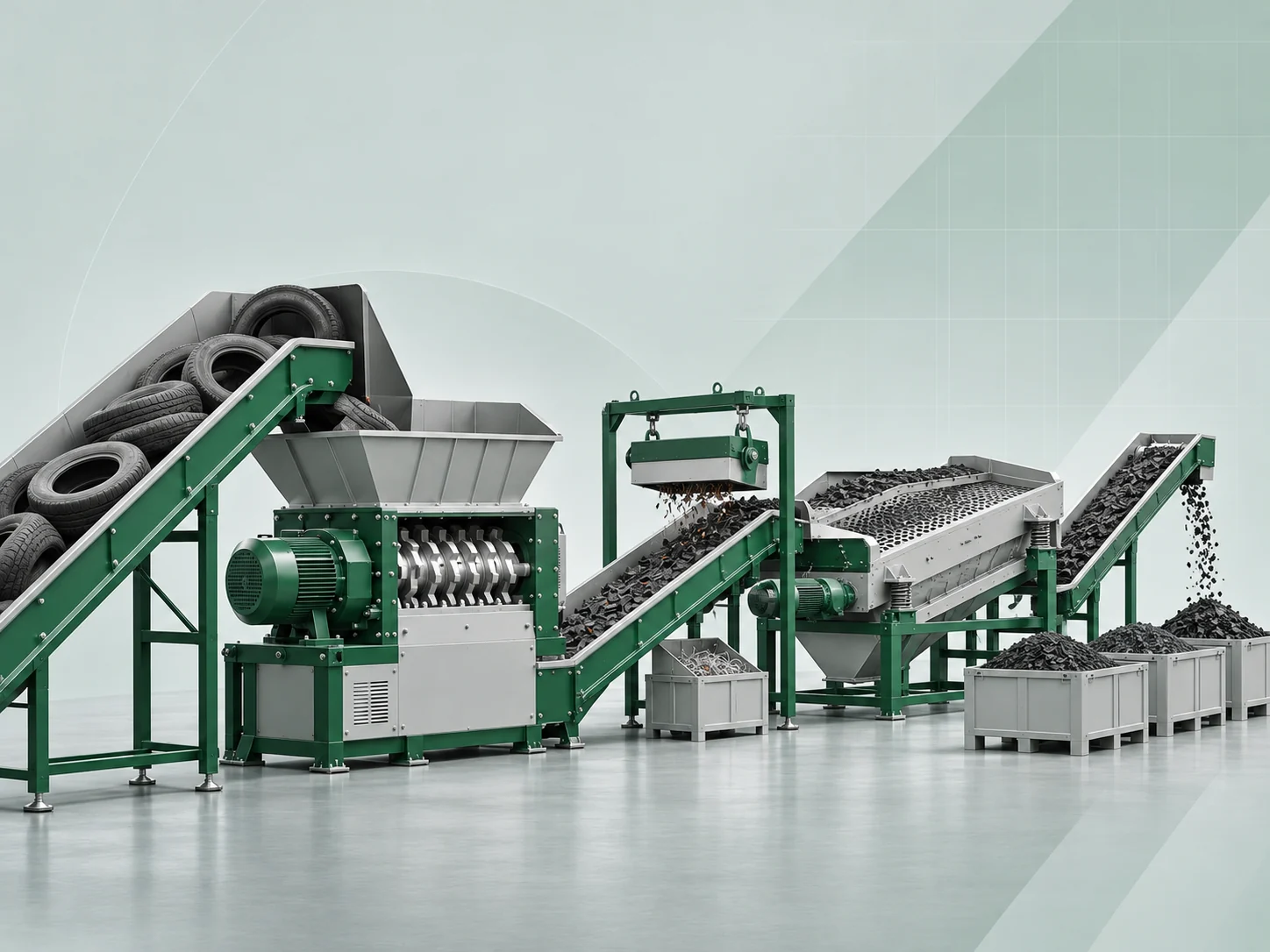
We review tire type and target output, then assess whether debeading or cutting is needed ahead of shredding. Magnetic separation, screening and further granulation may be considered according to the agreed scope.
Identify tire types and need for preliminary cutting.
Assess a high-torque primary size-reduction stage.
Review magnetic steel recovery and, if needed, fiber removal.
Match the fraction to the next processing step.
Illustrative workflow. The stages, equipment and acceptance evidence depend on the agreed project scope.
Whole tyres, reinforced pieces and clean rubber offcuts need separate feed descriptions.
These families provide a starting point for a manufacturer review of your specific feed and duty.
Technical review
Confirm passenger, truck or other tire type and maximum dimensions.
Describe steel and textile content and the intended separation target.
Define chip size, allowable residual steel and further processing.
Confirm feed method, throughput, power and maintenance access.
Project approach
Share representative feed, target output and site requirements.
Agree equipment stages, scope and representative testing where appropriate.
Document configuration, acceptance criteria, interfaces and delivery responsibilities.
Project enquiry
Tire & Rubber Recycling Line will be included in your enquiry. Add the feed details, target output and location to give the review a clear starting point.
Request a Quote